Saturday, 15 August 2009

Chicago, the favourite city

Chicago is a lovely city. Easy to walk. Public transport pretty good, except the old heritage train makes one helluva noise - you can't hear yourself talking when it passes by overhead. Went on the Architectural Cruise on the Chicago River. Thought it was too expensive (USD36) but it came with free drinks, coffee and cookies. The commentator seemed very well-informed and the upper-deck was packed. Everywhere we could see queues of people waiting for their boat rides. So that is big business; there's more than one architectural tour company. Which makes me wonder why they haven't got a system to visually or physical identify buildings to help idiots like me focus on the building when the commentary is going on. "the building on the right", "the one on the left" ... I was completely lost most of the time which building he was talking about. Anyway, as I said, I can only take about 15 minutes and then I go blank when it comes to guided tour. To top that, I hadn't slept the whole of previous night. Ah, but learnt about how the used shovels (yes, not monster excavators) to dig through the glaciers so that they could force the Chicago River to reverse its flow. Why you ask? Because the river had become a rubbish and sewer dump. Not surprisingly, the states down river didn't think much about dumping the rubbish in their backyard and sued. But lost. It wouldnt' have happened in this day an age (it happened like maybe a hundred years ago; not sure).

Our presentations by the international panelists from Malaysia (me), Taiwan (Yeh SC), India (Kiran) and Scotland (Andrew) went very well. Each of us had only 7 minutes but I think I cheated. Yeh said I probably spoke for 10. It was very short so it was mainly overview.
Shin Cheng and Andrew
Lik Meng and Harold. Kiran hidden behind me.

The presentation by the President of the US Green Building Council was I thought very good. Presentation skills very good. Slides excellent. But I think the message was more important. He was very pushy. Yes, everyone thinks that its just a scam to make money. When they started more than 10 years ago, people slammed their doors and won't even talk to the greenies from the Council. Now it seems that there are more than 100,000 LEED AP (accredited professionals), people who are certified to help you achieve LEED certification. According to the guy, the amount of money which the Council gets to give you the cert is very small; sometimes even just one cent per sq foot; sometimes as hight as 11 cents. So that's very small. Most of the added cost is the professional consultants to help you through the design, modelling, and documentation for submission to get the certification. One question from the floor was concerning building owners who wanted to meet the criteria for green buildings but didn't want to go for certification. The response was that certification is a third party validation. So you know what the owner claims is true. Apparently (at least according to a few people at the Summit), students (68%) are demanding that their universities go for green buildings; some said that students are also asking whether the universities have green buildings when they apply for admission.
The Green Building at University of Illinois Chicago. On the right is the refurbished green portion, on the left is the original building. Used for lectures.

This, I thought, was neat. Greening the roof with shallow plastic plates planted with what I think are desert-like plants. A student project at Saint Xavier University.

We met a lady who was an exchange student in Taiwan and she now works as a "Carbon Accounting Coordinator". So, that's a new green job. She says she can help teach or guide our students in compute our GHG. I told Yeh that if he invites her to Taiwan, then I will maybe invite her to Penang. Save some carbon, right?
Another green business. Organic and local. But still alot of plastic wraps. The book to put the apple, bag of chips and the turkey sandwich was really unnecessary.

OK, better stop before my one hour Internet credits cuts me off again. (BTW, I was cut off so this is delayed posting again).

A "clean air hybrid bus". We should explore having these on USM campus.

Friday, 14 August 2009

Green buildings

I went for the tour of three green buildings in 2 campuses in Chicago yesterday. Today, its all about climate change. President Bill Clinton gave a keynote amidst tight security. He was selling climate change. Well, he was telling the audience all about how working to solve global warming can create millions of jobs and told them about various financial instruments available for universities planning on greening their campuses. Perhaps that's the significant factor in America. You really got to justify the costs. Someone said he was incredulous when one participant asked what is the payback period for the whiteboard in the classroom of the green building.

During the green building tour we visited two new residential halls and a retrofit of a lecture/class room complex. From various conversations, I gather that even if you say improve efficiency by 30% it may still not lead to sustainability. Because the reduction is based on a baseline which is really way too high in consumption of energy in the first place. Even geo-thermal is not really "free" because it involves a lot of pumping of the water to carry heat either into the ground or from the ground to the building (depending on summer or winter). Then there was a LEED certified practitioner (she certifies LEED buildings) who did not think that the current way is going to lead to sustainability because it lacks the social-culture elements, e.g. using local or indigenous knowledge or skills or materials. Another thing we talked about is that some of these green buildings are designed as a closed system. E.g. some buildings have floor to ceiling glass windows which cannot be opened. Why? Cause people opening the windows will screw up the smart building operating system.

One question which I put forth to several people is will tackling climate change lead to sustainability. Most agree it is a necessary condition but not sufficient. Climate change is only one part of the sustainability agenda. One lady say maybe 1/12th; one director sustainability at a Michigan university said maybe about half. Me, I don't know, but I think definitely not more than one quarter. So, why the focus on climate change and not the larger sustainability agenda? My take is that going carbon-neutral is much much easier to set targets, implement, measure and attain. So, it is good. We will learn from their success and failures.

Dinner was at the Cultural Centre. We had beef which was from a local source. (BTW, one of the criteria for green buildings is that the construction materials must come from within a 500 miles radius). And the guest speaker was Janine Benyus, author of Biomimicry. I bought the book two weeks ago in KL and is a must read for anyone thinking about doing sustainability. Her talk was really very good with some really lovely pictures (will try to get them). She actually walked passed about 10 or 15 minutes ago (it is pass midnight here) and she said Hi, as though she recognised me from somewhere (am sitting in the lift lobby; haha). I was busy being a keyboard monkey. Will try to go say Hi to her tomorrow if she is still around. I love what she said about the know should be available everyone, not patent. Just patent your products. Unfortunately, I am still in jetlag so though she was really engaging, I nodded off a few times. But I have read her book. Her talk just reinforce my respect for her work.

This seems to be a very historic hotel, with over 1,000 rooms. Clinton said he had his victory celebration. Of course, all hotels try to be green. They have card telling you, please reuse your towel by hanging them on the hook (put them in the bathtub if you want it changed). I having been hanging it up on the hook everyday. But everyday when I come back to the room, there is a new towel on the rack. And the air-condition is terribly cold, especially for us from hot climates. There's also a sign saying the try to be green by, amongst others, not using disposable cups and utensils. Well, disposal paper cups are available for the coffee breaks (along with the reusable porcelain cups). But the most telling thing is that probably about half the participants choose to use the disposable cups. So ... I guess we are a long way off from sustainability.

(p.s. this original post did not go through. This is a delayed posting)

Wednesday, 12 August 2009

How're U Doing?

One of my concerns is whether USM is really up there in front when it comes to sustainability. Are universities elsewhere already far ahead that it’s makes no sense trying to claim a front seat. Or in our case, claiming that we will become world renown by choosing the sustainability platform. If you search the web you will find many universities with various efforts, with a few claiming efforts dating back 10 years. Or more. So can USM really claim that we are really forging the path under our APEX U transformation plan? Well, in the last few hours I found out that even though hundreds or perhaps thousands of universities have signed and made commitments for climate change and sustainable development, most have no idea what it really means. Just about everyone is struggling to operationalise the ideals. So, I am comforted in two ways. One, USM is out in front. Two, I was quite right in bugging USM to walk the talk. When the time comes, we will have to show proof that we have indeed moved towards sustainability. I have no doubt that it is impossible to achieve sustainability in the near term. Definitely not in 5 years. Not even in 20. We have not even agreed on how we should measure “having achieved sustainability”.

Ah, so how is Chicago? As usual, my preferred mode to see the city is to walk. Very carbon-neutral, eh? According to the clock on my notebook, it is 1.20 pm Wednesday in Penang. According to the hotel room alarm clock it is 12.22 am Wednesday. So I am about 13 hours behind. Jetlag is always a problem for me.

There’s no WIFI in the hotel rooms; they only have cable Internet in the rooms. WIFI is available in the public areas like lobby, charged thru the credit card at USD6.90 for one hour – then you get logged out. Hhmm, maybe that’s a good model cause I then don’t spend too much time online (am writing this on word-processor first before going to upload; will save me precious online time). But it’s cheaper if you use the cable Internet which only USD14 for 24 hours. But you don’t need 24 hours online, right. Go see the city!

Which is what I did after going to sleep at 4 am, forcing myself to get up at about 8 am. Skipped breakfast (actually skipped dinner the previous night too) and started walking towards the Navy Pier which is almost like the Pier 49 of San Francisco. Along the way spent sometime wondering in the Millenium Park. Its got some lovely public art but I think the most important thing is the activities they organise. This month there are some free concerts. You can even watch them rehearse. And the open air auditorium is really cool. It has the formal amphitheatre-style seating in the front and then at the back is a green lawn. What’s unique about the auditorium is the wire-meash steel structure “covering” the theatre. And hanging down are speakers and just from the cello guy rehearsing you can hear it crisp and clear. And you know these Americans are sun-worshippers. So you will find them on deck chairs or lying down on blankets on the green lawn (saw pictures of theses).

It's called the Jay Pritzler Pavilion but I call it the Amphitecture +

When I saw this sign on the right (which are a many around the park), I started looking around for those famous banners we have on our campus. I couldn't find any. Could this be one of our solutions? Moveable, very personal (eye-level), readable (no dangering to moving vehicles and drivers), reusable.


If you are wondering why this picture is so blurry, its because the public like to touch it. The poor worker has to continuously wipe it. This is a reflection of me in a public art entitle the Cloud Gate at the Millenium Park. I think a drop of mercury is how I would describe it but with a "gate" at the base.


Along the way to the Navy Pier, saw a bunch of tourists practicing on the Segway. Maybe I will try one if I have the time. They market it as carbon-neutral tourism of course. Another carbon-neutral sightseeing is by bicycle. This is really big here. You can do it on your own or in guided tours. There’s even paddy cabs for familyies where four people can paddle at the same time, with space for another two smaller kids up front. I am not so sure people do it for the carbon. Just a new market I think. The hop-on-hop-off buses are doing roaring business but I am avoiding them. I get annoyed with all the yakity yak after 15 minutes. Boat rides and boat tourss are also big business, with one boat ride along the Chicago River called the Architectural Tour. Yes, Chicago has many significant architectural masterpieces dating back more than 100 years. Way back in the 1800s they were already constructing buildings more than 10 storeys high using steel frames.

Cycling tours has become big business.


And Navy Pier? Lot’s stuff there. But honestly, a tourist from Malaysia will probably complain –“nothing to do one”. Lot’s of people just enjoy walking or cycling or riding the boats with families and friends. Or have food. Of course, what is America without the beer. There’s the famous ferris wheel; largest one around or something. Modelled after the one at the first World Expo held in Chicago – ages ago. Remember reading about it during my doctoral studies. The World Expo was used to showcase modern living.
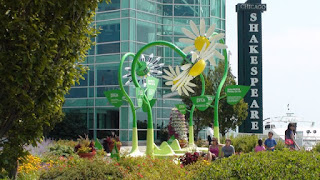
Can you guess what this is? It's called the Prius Solar Garden. Anyone?


Oh, yes food. Went to this place at the Pier plagiarising from the Forrest Gump movie. Since I had skipped dinner and breakfast I ordered salad and clam chowder and steamed mussels. Was I surprised when the food came. Huge. To my surprise I finished all except for the bread which I took back (the waitress offered a container which I declined). With a drink, that cost me about RM100. The exchange rate is terrible. Oh, the mussel was quite bland, even with the butter and some other dip. I thought it was not fresh enough.


And for dinner, we went to a Mediterranean restaurant. We, as in Harold (my host) and his wife and son, and Shih Chung from Taiwan. Guess what? We had mussels again but this was way better. And lots of other food, shared. And I had my first glass of gin and tonic – not bad.

Ah, not just dinner. We are networking.


Tomorrow, we have a pre-conference workshop to visit a couple of campuses to check out their green buildings. Harold and I agreed that the green building certification is a scam. Well, to be fair, we did not use the term “scam”, but you know what I mean. What’s more important is for universities to understand the motives behind green buildings. Will let you know what I think about the local examples after the tour.

BTW, I have been told to keep my presentation (Friday) strictly to seven minutes. So, you students reading this … take note.

You won't get to see this on your normal tourist package. While walking to the Navy Pier, I got into some deadends and discovered this elevator and stairs to get down to the street below. See what I see? The private spaces (balcony gardens) has merged into a sort of semi-public space. I love this.