Read the title again. Did you get it?
I'm trying to strategise. I'm thinking out loud. What do I want to do under Kampus Sejahtera for the next two years. (Yah, I guess I will just do it and stop whining about not wanting to be reappointed.)
One thing is clear. Whatever I do or instigate others to do, must (not should, must) contribute to USM's APEX University agenda. Nothing else matters.
Now, don't get the wrong ideas. I can't take on everything. I will be focussed. I will pick my "fight". Anything which does not fit into that focus, I will say NO. For instance, I want to see results from now on. I want to see impact from actions. Kampus Sejahtera is about action. Not research. Data gathering and analysis is essential but only if it assists in taking the right actions.
So, if you come to me and propose an awareness campaign, even if it is health related, I will not say no.I will not say yes either. I will tell you I want to see it lead to some results. Awareness does not automaticaly lead to transformation. In fact, it seldom does. Who does not know cigarettes gives you cancer (ok, increases your chances of getting lung cancer)? Everybody knows. Yet, they smoke.
Next, I want to see long term plans. We start a lot of things. They get a lot of buzz. And then we lose interest. On the casualty list are immensely successful efforts like The White Coffin. Who's baby is it now? I work a lot with student groups. The problem is their life-cycle is very short. Those in command (office bearers) stick around for one year and then a new batch wants to do new things. There's little continuity. They have to focus. What should each group or society be known for? Identify it and stick with it. Make it work. Make long-term commitments. That's going to be tough. We won't get the same level of energy each year. So, what are the priority areas? Pick a few. Work on it. Stop generating new projects every year. Wait a few years. Let the priority projects take root.
So, what's the priority areas? It should be decided by consensus. We should throw them on a table, discuss, take it apart, and select. It should be doable. But it should be high impact. It must lead to change. If there is no transformation, it does not contribute to the APEX U agenda.
Kampus Sejahtera is a USM brand. As conceptualised more than 10 years ago by the current Vice-Chancellor, it's about insourcing. Essentially, urging the campus community to offer their expertise to make the university a better place for all. Yes, the term volunteerism is key (in the sense that you don't expect the university to pay you extra honorarium). A central idea is that actions are based on sufficient understanding of the issues or problem through data analysis and documentation.
I have suggested that the sustainability agenda under the APEX programme be branded under Kampus Sejahtera. In fact this was what I suggested in 2007. But I'm not the sustainability officer, so don't expect me to do that job. I will promote the idea of sustainability, yes. I will pick projects which will help achieve sustainability, of course. But we don't want to be myopic and not see anything else. I don't have a final answer yet and this will probably always be work in progress. Certainly I'm not working to present a Report which says that we have achieved sustainability. That would be the job of future generations, perhaps 20 or 50 years from now.
But in the meantime, if you want to do it your own way, that's fine with me too. That does not mean I won't bug you about coming on board. Are you with me? Or against me? (smile, it's a joke)
Thursday, 27 January 2011


Wednesday, 26 January 2011
What's L.O.V.E. gotta do with it?
Recall this, "Calling all Volunteers" February 2010 which was followed by this "Student-Community Convention 2010" in April. The intention was to bring various student groups involved in community work to come together, to share, to spur the effort. The attendance was poor, about 20 students attended the one day event. It was organised by 4 student groups at my instigation. My analysis was that there was no ownership by any particular group. Of course, number is not the only yardstick to measure success. Many groups are tight knead small groups but effective. One conclusion we could make was students are no interested in volunteering or community service. Students just want to be left alone to study.
But less than one year later, the landscape seems to have changed. I believe it was brilliant packaging, excellent organisational skills, a sense of OWNERSHIP, and savvy marketing which carried the day. It was reported that 500 people signed up to volunteer during the one day L.O.V.E. Festival yesterday. See them on Facebook and on the web. I am sure that it was a team effort but it also needs exemplary or extraordinary leadership to carry through any project or event. Essentially, you need the right people for the right job.
So, Well Done to the AIESEC team under Wilson Beh (I hope I didn't screw this up and get protest emails).Of course we should recognise that the Right Livelihood College in USM played a pivotal role too. RLC had earlier proposed something called USMCares as a programme to train volunteers but as usual, where's the money?

So, what's love gotta do with volunteering? Everything, no matter which angle or perspective you wish to scrutinise it.
I was asked how I see "volunteerism" at the Lollipop talk show about 2 weeks ago. I said firstly, "you must want to do it". Secondly, "you must do it for the good of others". You must not be compelled or coerced in anyway. And whatever you do must benefit some one else who needs it. It's not about what you will get out of it personally, or as an institution.
If I could expand it a little, it is not charity. Giving money or donations does not make you a volunteer. You gotta to put in the time and energy.
And usually, this is where the obstacles are. Finding the time, on a consistent and continuous basis is essential. This is where it then translate into a true spirit of volunteerism. You do it not because you hope to get an award for best project. You do it not because of a certificate or merit points for hostel eligibility. You do because you know it is the right thing to do to help someone(s) less fortunate than you.
So, ultimately, and I have said several times before openly and at meetings, the measure of our (the university's) success in community service and volunteering must be measured by the positive effect or impact that we have made on the target community. How many poor people have we help to get out of poverty through education or self-help? How many deaths have we prevented with the new drugs we invented? What percent of our staff are from unprivileged backgrounds or with disabilities?
We should be selective. We need to be selective. Where could we make the most impact?
OK, I hear you. Surely, there must be some benefit to the student or staff who is volunteering? Should we not also measure that? A valid point. We should "measure" how we have created the spirit of volunteerism amongst students and staff. It's actually already there among the staff and students. They are already doing it. We just have not recognised them - we have not acknowledged them. We should seek out groups and individuals in the campus who have persistently and quietly worked for the benefit of others and garner their spirit.
Certainly, I do know there are many models or conceptualisation of volunteerism. The PeaceCorp is a world famous volunteer group where U.S. citizens work overseas for long periods of 2 years or so. I remember one Peace Corp volunteer from my school days, a Mr Martin who taught us maths. Obviously you can't expect them not to get any allowance - how would they live? Same goes to organisations like Doctors Without Borders - volunteers get airfare, accommodation and allowance (which is "small"). Then there is the Tzu Chi group where their volunteers pay for their own airfare when they go for disaster relief work.
I believe L.O.V.E. has the potential to be immensely successful. But I still cannot see where it wants to be. Getting lots of people to sign up as volunteers is only a small step. Will they be happy with this measurement?

(p.s. as a historical note : I received an email requesting a link on the healthy campus website for L.O.V.E. Also got a phone call, presumably from one of the students in the team, asking whether I would be part of the effort. I was little stunned. I said "I'm still evaluating" - see above. But get this. Kampus Sejahtera is a concept. An idea. Everyone is USM should use. Everyone can use it. And the healthy campus website isn't the best place to publicise your event - as proven above)
But less than one year later, the landscape seems to have changed. I believe it was brilliant packaging, excellent organisational skills, a sense of OWNERSHIP, and savvy marketing which carried the day. It was reported that 500 people signed up to volunteer during the one day L.O.V.E. Festival yesterday. See them on Facebook and on the web. I am sure that it was a team effort but it also needs exemplary or extraordinary leadership to carry through any project or event. Essentially, you need the right people for the right job.
So, Well Done to the AIESEC team under Wilson Beh (I hope I didn't screw this up and get protest emails).Of course we should recognise that the Right Livelihood College in USM played a pivotal role too. RLC had earlier proposed something called USMCares as a programme to train volunteers but as usual, where's the money?

So, what's love gotta do with volunteering? Everything, no matter which angle or perspective you wish to scrutinise it.
I was asked how I see "volunteerism" at the Lollipop talk show about 2 weeks ago. I said firstly, "you must want to do it". Secondly, "you must do it for the good of others". You must not be compelled or coerced in anyway. And whatever you do must benefit some one else who needs it. It's not about what you will get out of it personally, or as an institution.
If I could expand it a little, it is not charity. Giving money or donations does not make you a volunteer. You gotta to put in the time and energy.
And usually, this is where the obstacles are. Finding the time, on a consistent and continuous basis is essential. This is where it then translate into a true spirit of volunteerism. You do it not because you hope to get an award for best project. You do it not because of a certificate or merit points for hostel eligibility. You do because you know it is the right thing to do to help someone(s) less fortunate than you.
So, ultimately, and I have said several times before openly and at meetings, the measure of our (the university's) success in community service and volunteering must be measured by the positive effect or impact that we have made on the target community. How many poor people have we help to get out of poverty through education or self-help? How many deaths have we prevented with the new drugs we invented? What percent of our staff are from unprivileged backgrounds or with disabilities?
We should be selective. We need to be selective. Where could we make the most impact?
OK, I hear you. Surely, there must be some benefit to the student or staff who is volunteering? Should we not also measure that? A valid point. We should "measure" how we have created the spirit of volunteerism amongst students and staff. It's actually already there among the staff and students. They are already doing it. We just have not recognised them - we have not acknowledged them. We should seek out groups and individuals in the campus who have persistently and quietly worked for the benefit of others and garner their spirit.
Certainly, I do know there are many models or conceptualisation of volunteerism. The PeaceCorp is a world famous volunteer group where U.S. citizens work overseas for long periods of 2 years or so. I remember one Peace Corp volunteer from my school days, a Mr Martin who taught us maths. Obviously you can't expect them not to get any allowance - how would they live? Same goes to organisations like Doctors Without Borders - volunteers get airfare, accommodation and allowance (which is "small"). Then there is the Tzu Chi group where their volunteers pay for their own airfare when they go for disaster relief work.
I believe L.O.V.E. has the potential to be immensely successful. But I still cannot see where it wants to be. Getting lots of people to sign up as volunteers is only a small step. Will they be happy with this measurement?

This tireless couple are truly and without question the embodiment of the spirit of volunteerism. They persist against all obstacles. Every single cent they collect from their recycling programmes goes to selected charities on rotation. They give talks for free (hey, they are retirees without income so do cover their cost of travel). And they don't take no for an answer ... when it comes to pushing the environmental message.
Long live, Don and Mylene.
(p.s. as a historical note : I received an email requesting a link on the healthy campus website for L.O.V.E. Also got a phone call, presumably from one of the students in the team, asking whether I would be part of the effort. I was little stunned. I said "I'm still evaluating" - see above. But get this. Kampus Sejahtera is a concept. An idea. Everyone is USM should use. Everyone can use it. And the healthy campus website isn't the best place to publicise your event - as proven above)
Thursday, 20 January 2011
Lollipop GLee - students just wanna have fun
First he said they wanted to put me in an Oprah show. Then it was David Letterman. There was also mention of the LikMeng Morning Show.
Essentially, they wanted to put me on the spot for 60 minutes in front of a lecture hall full of students and dig out juicy secrets.
Why? Well, they just wanted to have fun. To do something different. And it would be a saturday morning. Usually, I say no to invitations for weekend activities with student groups. Especially if it's for some opening or closing ceremony.
He promised me FUN. So, why not?


Yes, they asked some intrusive questions : did you ever had head lice? I also gave some life lessons on romance and love too - nothing X-rated.
As usual, Malaysian audience are very shy but two questions from the floor jolted me a little.
It started innocently.
host : how long have you been teaching in USM?
me : about 20 over years. I started in June 1985.
host : oh, we weren't born yet. (there were a lot of smiles in the audience ... and I momentarily felt old)
Then from the audience, "based on your more than 20 years of teaching experience, what changes do you see in the students?". I was a little stumped. Didn't expect the question. Yes, I didn't ask for the questions before hand. It was totally impromptu.
My immediate reaction was that I didn't think students have changed much in the last 20 or 30 years. We are still doing the same things to the students. I get the same "type" of students every year. We are training them in pretty much the same way in the primary and secondary schools. So, when they come into the university, they have the same qualities in terms of study habits and learning styles. I even mentioned the dirty word : "spoon feeding". Certainly they are "afraid" to challenge the lecturers.
I could sense the students were a little "unsettled". I sensed that they expected something positive or uplifting. A compliment perhaps. I said, "give half a minute" to think. I raked my brain. What has changed? What has changed? I certainty couldn't talk about all the other things I wrote in my other blog (Don't blame the old man; Is the doctor giving you the right medicine; or the more light-hearted "Just One more day").
And then I had an aha moment. I said "students have become more brilliant". My children are more brilliant then me - "so, it's not genetic". "You are all more brilliant then students of the past". I watched the body language. There was some shifting in their seats. I saw some little shy smiles.
I asked them what they are good at. Which part of the brain they have been trained to use? They know. The left brain. Logical thinking. Reasoning. Analytical ability. Memorisation. So, I broached the subject of multiple intelligences. So, yes, we, as an education community, have become excellent in developing the left-brain. We have trained our children to get better results in exams. What we need is to develop the whole brain, I said. (good recovery, don't your think?)
I enjoyed myself. I think activities like these are valuable lessons outside the classroom. I am sure there are many such activities. I hope to bump into them more often in the future. I also see that are students who are beyond brilliant - thinking up programmes to provide fellow students with somethings the traditional classrooms cannot or refuse to provide. Taking charge of their lives, there is hope yet for the future generations.


Essentially, they wanted to put me on the spot for 60 minutes in front of a lecture hall full of students and dig out juicy secrets.
Why? Well, they just wanted to have fun. To do something different. And it would be a saturday morning. Usually, I say no to invitations for weekend activities with student groups. Especially if it's for some opening or closing ceremony.
He promised me FUN. So, why not?

15 Jan 2011 Saturday, DK Y, at the Pharmacy School, USM. In the centre is Rhuyann, former President of Green Lung and on the right is ahhhh (?sorry, not good with names), the so-called hosts. Photo stolen from Saphira Queen's fb.


Always good to get the crowd on your side first! About 80 of them, mostly pharmacy students, all members of Green Lung.
Yes, they asked some intrusive questions : did you ever had head lice? I also gave some life lessons on romance and love too - nothing X-rated.
As usual, Malaysian audience are very shy but two questions from the floor jolted me a little.
It started innocently.
host : how long have you been teaching in USM?
me : about 20 over years. I started in June 1985.
host : oh, we weren't born yet. (there were a lot of smiles in the audience ... and I momentarily felt old)
Then from the audience, "based on your more than 20 years of teaching experience, what changes do you see in the students?". I was a little stumped. Didn't expect the question. Yes, I didn't ask for the questions before hand. It was totally impromptu.
My immediate reaction was that I didn't think students have changed much in the last 20 or 30 years. We are still doing the same things to the students. I get the same "type" of students every year. We are training them in pretty much the same way in the primary and secondary schools. So, when they come into the university, they have the same qualities in terms of study habits and learning styles. I even mentioned the dirty word : "spoon feeding". Certainly they are "afraid" to challenge the lecturers.
I could sense the students were a little "unsettled". I sensed that they expected something positive or uplifting. A compliment perhaps. I said, "give half a minute" to think. I raked my brain. What has changed? What has changed? I certainty couldn't talk about all the other things I wrote in my other blog (Don't blame the old man; Is the doctor giving you the right medicine; or the more light-hearted "Just One more day").
And then I had an aha moment. I said "students have become more brilliant". My children are more brilliant then me - "so, it's not genetic". "You are all more brilliant then students of the past". I watched the body language. There was some shifting in their seats. I saw some little shy smiles.
I asked them what they are good at. Which part of the brain they have been trained to use? They know. The left brain. Logical thinking. Reasoning. Analytical ability. Memorisation. So, I broached the subject of multiple intelligences. So, yes, we, as an education community, have become excellent in developing the left-brain. We have trained our children to get better results in exams. What we need is to develop the whole brain, I said. (good recovery, don't your think?)

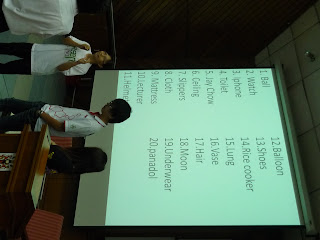
Coincidentally, they invited a masters student in pure mathematics who is like No. 6 in the World as a master of memorisation. He taught them a method to remember a long list of items. After the training, three students demonstrated they ability to remember in sequence 20 items suggested by the audience. They only had about 5 minutes to memorise the list and all three did it perfectly (and got a Tupperware tumbler courtesy of yours truly). I wonder if it is really the method or they are already experts in memory work from more than 13 years in the schools. Perhaps both. But I also pointed out that an even more important message from the previous speaker was to learn how to think differently (another day perhaps).
The other question which impressed me was what I thought of destiny. This followed my telling them how I ended up in academia. I was "destined" to go into the private sector and earn big bucks but a phone call from the then Dean of HBP changed my life. This gave me the opportunity to talk about scenario planning. Well, yes I believe there is a destiny. But you can change your destiny. Kinda of an oxymoron, isn't it?
I enjoyed myself. I think activities like these are valuable lessons outside the classroom. I am sure there are many such activities. I hope to bump into them more often in the future. I also see that are students who are beyond brilliant - thinking up programmes to provide fellow students with somethings the traditional classrooms cannot or refuse to provide. Taking charge of their lives, there is hope yet for the future generations.

A day long programme. It started with about 80 students. From facebook photos, it seems by VVIP, there was less than half. Abit too taxing?

It was totally my fault. I used to tell people not to give me any souvenirs. I don't need an extra mug. I can't eat the lollipop. And I certainly can do without the plastic flowers. But thanks anyway, Khang Siean, current president of Green Lung.
Well done!
Subscribe to:
Posts (Atom)